
Introduction
Many businesses start their software journey with low code platforms. These tools are fast and easy to use. They help teams build apps without deep coding skills. But over time, many companies face limits. At this stage, Low code to high code migrations become important.
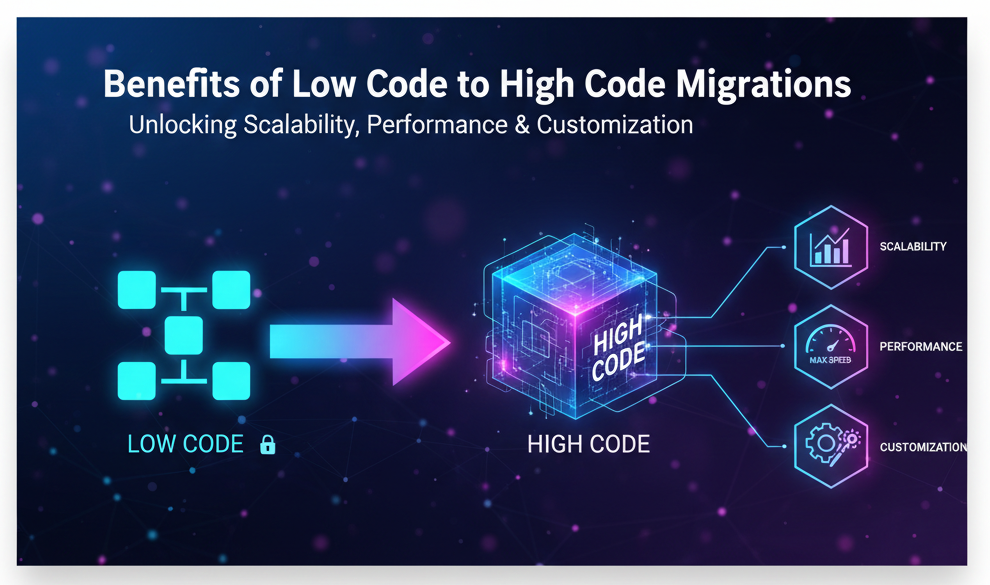
As apps grow, businesses need more control, better speed, and stronger security. Low code tools often cannot support complex needs. This is why moving to high code solutions becomes the next step. Low code to high code migrations help companies move from simple tools to full custom software.
This guide explains what Low code to high code migrations are, why they matter, and how to do them the right way. It is written for beginners and decision makers who want clear answers without hard words.
Low Code to High Code Migrations: What Are They?
Transferring an application from a low code platform to a conventional coded system is known as a low code to high code migration. Full programming languages like Java, Python, or JavaScript are used in high code systems.
For fast apps, low coding tools are fantastic. They make use of pre-made features and visual builders. However, they frequently restrict flexibility. Complete control over logic, design, and performance is possible with high code systems.
Rebuilding or converting the application into clean, scalable code is the aim of low code to high code migrations. Better future expansion and customisation are made possible by this.
Why Companies Opt for Low Code First
Initially, low code platforms save money and time. They enable small teams to develop quickly. Low code is a popular choice among startups and small businesses to rapidly test concepts.
Additionally, low code technologies lessen the requirement for skilled developers. Teams may launch apps more quickly as a result.
However, needs shift as the company expands. At this point, migrations from low code to high code are required.
Why Low Code Becomes a Problem Over Time
Low code platforms have limits. They restrict custom logic and deep system access. Performance can drop as apps grow larger.
Security control is also limited. Advanced features may cost more or may not exist at all.
Vendor lock-in is another issue. Your app depends fully on one platform. This makes change difficult.
Because of these issues, many companies plan Low code to high code migrations for long-term success.
High Code Development’s Advantages
Complete flexibility is provided by high code development. Custom logic can be written by developers without restrictions. Every level of performance may be improved.
Teams are in charge of the entire system, which strengthens security. It gets simpler to integrate with other tools.
Businesses acquire ownership of their software during low code to high code migrations. This lowers expenses and dangers in the future.
When Is It Appropriate to Move?
Not all apps require migration. However, there are indications that it’s time.
Migration might be useful if your program is sluggish, difficult to update, or costly to grow. High code is the solution if you require functionality that the platform is unable to provide.
Early planning for low-code to high-code migrations lowers risk and downtime.
Low Code to High Code Migrations: Common Problems
Data copying is not the only aspect of migration. It takes talent and preparation.
Understanding the current app logic is one of the challenges. A large portion of the functionality underlying visual tools is hidden by low code platforms.
Data migration presents another difficulty. Data must be sent securely and without loss.
Testing is also essential. The new system must function flawlessly following low code to high code migrations.
Step-by-Step Migration Method
Teams first examine the current low-code application. They record data, processes, and features.
They then select the appropriate tech stack. This is contingent upon future goals, budget, and performance.
The program is then rebuilt in high code by developers. This covers front-end, back-end, and integrations.
Lastly, deployment and testing happen. The ultimate objective of low code to high code conversions is a seamless launch.
Cost-related factors
At first glance, low code appears inexpensive. However, restrictions and licensing may cause long-term expenses to increase.
The initial cost of high code development is higher. However, it provides greater scalability and lowers platform expenses.
Over time, many businesses discover that migrating from low code to high code is economical.
Benefits of Security and Compliance
Custom security rules are possible with high code systems. For sensitive data, this is crucial.
With complete control, compliance obligations are simpler to handle.
Businesses can comply with stringent security requirements following low code to high code migrations.
Enhancements in Performance Following Migration
Applications with high code execute more quickly. Logic and queries can be optimized by developers.
Load management gets better. Apps don’t have to slow down to accommodate more users.
This is one of the main reasons businesses decide to migrate from low code to high code.
Maintenance and Prospective Development
Vendor updates are essential for low code platforms. Unexpected changes may result from this.
Your team has complete control over high code systems. Updates take place according to your schedule.
Migrating from low code to high code is therefore a wise strategy for long-term growth.
Choosing the Appropriate Migration Partner
Not every team has internal talent. You can get assistance from a migration partner.
Select professionals with low-code to high-code migration experience. They are knowledgeable with both bespoke code and platforms.
A competent partner expedites delivery and lowers risk.
FAQs
What are Low code to high code migrations
Low code to high code migrations mean moving apps from visual platforms to full coded systems.
Why do companies migrate from low code
They need more control, speed, and flexibility.
Is migration risky
With proper planning, Low code to high code migrations are safe and effective.
How long does migration take
Time depends on app size and complexity.
Can data be moved safely
Yes. With correct tools and testing, data stays secure.
Final Thought
Low code platforms are a great starting point. They help ideas grow fast. But growth brings new needs.
Low code to high code migrations give businesses control, power, and long-term stability. They remove limits and unlock full potential.
With the right plan and team, migration becomes a smart investment. It supports performance, security, and future success.